
A Snapping Turtle Named Flannel and the Invention of the “Turtle Girdle”

DISCLAIMER: Even though this appears to be a straightforward procedure, it is actually very technical and requires extensive knowledge of the turtle’s anatomy. Never try to perform this, or any other medical procedure at home. Trying to “fix” an injured turtle at home using household items like glue or various types of tape is illegal, can cause further serious injury, extensive pain and even the death of the turtle. These procedures are performed in the clinic by trained clinicians using medical grade and medically approved equipment and supplies.
A Message from the Author
I recently had the opportunity to witness just how creative the technicians at Turtle Rescue League need to be. I already knew how dedicated and caring these women are, but this particular case was different and I really wanted to document and share it. I think it highlights just how fortunate we are to have access to such a top notch turtle rescue and rehabilitation center. I believe it’s important for people to see and understand the work that is done here every day and also spread the word that there are resources available right here in Massachusetts should you come across an injured turtle.
Turtle injuries can often appear very severe and to the average person, these injuries may seem hopeless. That couldn’t be further from the truth. Turtles have managed to live in the wild to be well over 100 years old. That in itself shows just how resilient they are. I wanted to write about this particular case because I think it’s important to share these stories so everyone can see that there is help, and there is hope, and that it’s so important to make the effort to seek out help as soon as possible if you do find an injured turtle. It literally makes the difference between life and death.
That said, I would like to share with you a story about a severely injured turtle who came to be known as Flannel, and the efforts that were, and are, being made by the staff at Turtle Rescue League to save her life.
Flannel’s Injuries
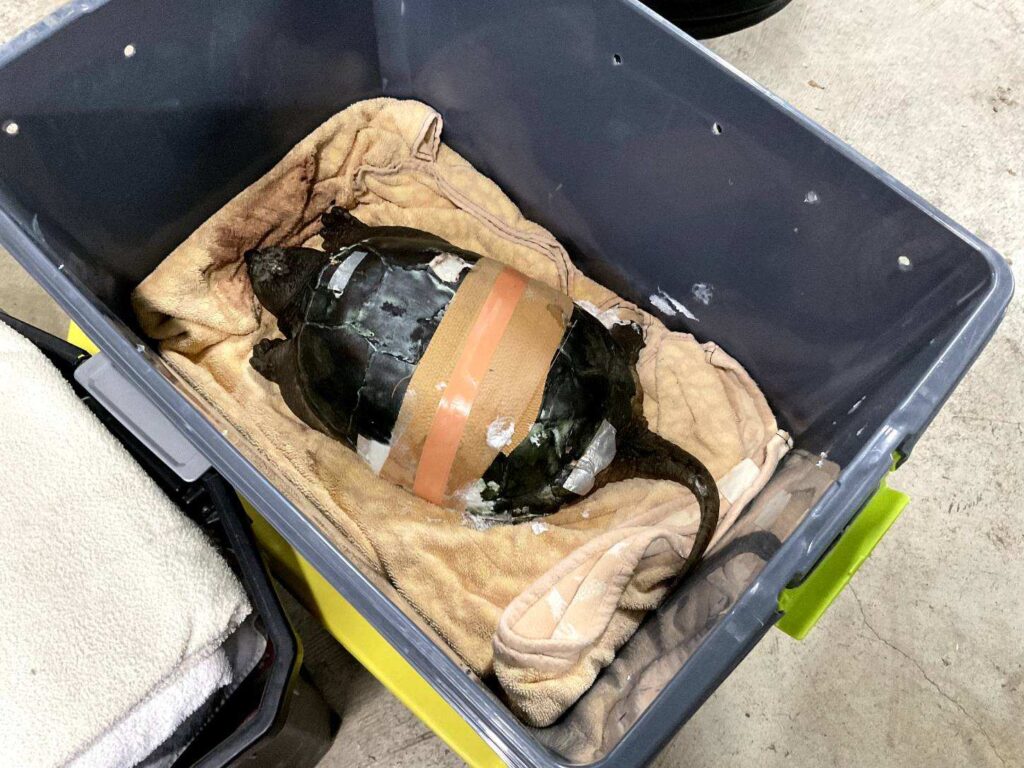
On June 1, 2022 the Rescue received a call about a mid-sized female snapping turtle that had been run over by a vehicle in Lawrence, MA. Upon arrival at the clinic, patient #2022-068 was in extremely critical condition. She suffered multiple shell fractures, including a complete fracture of both of her bridges, the hard shell located on each side of the turtle’s body holding the upper and lower shells together. Because of the number of shell fractures all over her body, her organs were moving freely around inside her with nothing to hold them in place. These injuries were painful for the turtle and made it difficult for her to breathe.
She would be impossible to treat with the standard methods used for repairing shell fractures. At a high level, shell fracture injuries are normally realigned and held together using a special aluminum tape and glue, and then covered with the same cream used by human burn victims to prevent infection. This method was attempted during the initial stages of treatment, but the repairs didn’t hold.
Because of the amount of damage done to the upper and lower shells and bridges, every time the turtle moved its limbs, the repairs would come apart and her organs would shift, becoming exposed through her open wounds.
Alexxia Bell, President and Chief Technician at the Rescue, quickly realized that the normal treatment methods would not be effective for this poor snapping turtle. She sat quietly and pondered what treatment options she had available to her that would literally hold this turtle’s body together and keep her internal organs in place. This was a complex puzzle that required complete focus.
To complicate matters further, this turtle was gravid, which meant she would soon have no choice but to try to push an unknown number of eggs from her broken body.
Could She Be Saved?
Because of the extent of her injuries, some might have decided this turtle wasn’t worth the time and effort to treat – but not Alexxia. If there is any hope at all, she will do everything in her power to make it happen.
There is always risk involved with such serious injuries. There is no guarantee that the turtle won’t suffer an infection or some other major setback.
Natasha Nowick, TRL’s Facility Director, explains that a turtle’s recovery can be broken into three stages:
- The first three days – the initial critical period. If a turtle suffering from serious internal bleeding is going to die despite treatment, it is likely to die in this stage.
- The next three weeks. If the turtle suffers from infection or organ failure, it often succumbs in this time period.
- The next three months. If a turtle develops a secondary infection after the initial injury, it’s likely to happen in this stage, before the wounds have had time to heal completely.
At this point, Flannel had reached one major milestone, she had survived the initial three day critical period.
Flannel’s Treatment – the Turtle Girdle

After careful evaluation of Flannel’s overall condition, it was apparent that there was no injury or trauma to her head. She was still fairly active, and if Alexxia could find a method of repair that would hold up to her activity, this turtle had a chance to not only survive, but to thrive.
After much thought, Alexxia decided a new type of brace was needed. It would have to wrap completely around Flannel’s shell, from carapace to plastron, once everything was realigned, holding it all in place until the fractured bridges could heal.
A turtle girdle.
This method was developed by Alexxia, and is based on the same types of techniques that would be used to treat human bone fractures.
Once the plan was in place, Alexxia needed to pick up some supplies. She would perform the procedure the next day. She re-taped the turtle’s wounds and wrapped her in an ace bandage to hold things together as best as possible for the night.
The next morning Alexxia gathered her supplies, which included a metal strap, some short screws and a few tools. The turtle was reevaluated and it was determined that she had done well throughout the night – she was showing no new signs of distress. She was given her first round of medications which included pain and anxiety medicines. These would help to keep her calm and to make the procedure as comfortable as possible for her. After some time passed a second round of meds were given and the procedure could begin.

Natasha carefully removed Flannel from her hospital box, taking care not to put any pressure on her wounds. She positioned the turtle in her lap, upright, with the bottom portion of the shell (the plastron) facing Alexxia. The bandages from the night before were carefully removed and all of the open wounds were cleaned and prepped with antiseptic.
Next, Alexxia spent a significant amount of time carefully and methodically realigning all of the broken pieces. Once everything was in its proper position, she used the special glue to hold it all together until she could place the turtle in the brace, or the “turtle girdle”.
She then measured the turtle, and the metal strap, and cut a piece just long enough to wrap around the turtle’s body. She drilled four pilot holes into the strap – two for the screws that would be placed into the top shell (carapace) and two more for the bottom shell (plastron). Once she had the strap wrapped around the turtle’s body and aligned in the proper position she inserted four short screws through the strap and into the turtle’s shell.
Once she was done, Alexxia moved Flannel’s limbs around and everything held together perfectly! She remained calm throughout the entire procedure, and she never showed any signs of being in pain or distress.
After everything had time to set, she was cleaned, dried and the burn cream was applied. Bandages were placed on top, and she was wrapped in gauze.

Results
The procedure went perfectly and exactly as planned. Flannel was given a broad spectrum antibiotic and medication to keep her comfortable.
Within a few weeks of the procedure, Flannel was strong enough to lay her eggs, 35 in all. This made her much more comfortable. The eggs were incubated and hatched at the Rescue and Flannel’s babies were released in early September.
Flannel’s recovery has been exceptional. The turtle girdle was removed after about 8 weeks. She eats well and her shell fractures continue to heal. She is an awesome snapping turtle and she absolutely loves it when someone approaches with well deserved treats and attention.
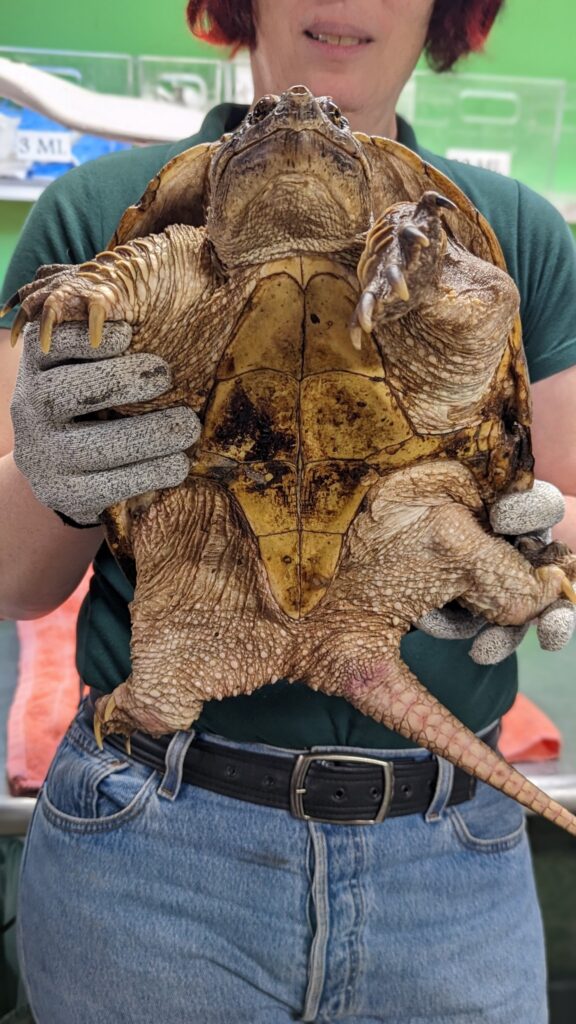
She has passed through all of the three main recovery stages at this point and there is no reason to think she won’t make a complete recovery. People should know that everything humanly possible was done to give her the best chance of survival, and it certainly paid off.
When Flannel finishes healing, she will be returned to her home wetlands.

Can You Help?
The Turtle Rescue League is a 501(c)(3) nonprofit organization that relies on the generosity of donors to keep the Rescue operating. Expenses for medical supplies alone are very high. If you are interested in making a donation to Turtle Rescue League in honor of Flannel (#2022-068) and the more than 200 other resident turtles and tortoises, please follow the link below. Every donation, large or small, is greatly appreciated and will be put to good use. 100% of donations received go directly to the care of turtles and tortoises.
If you are unable to make a monetary donation but still want to help, the Rescue is always in need of lightly used bath and hand towels, laundry detergent pods, bleach, and paper towels. To donate supplies, contact Natasha Nowick to make arrangements. She can be reached at (508) 404-7887.
Michelle Schweitzer
Turtle Rescue League Board of Directors