Turtle In The Road – What Should I Do?
Help it across the road!
First, be safe while helping the turtle, busy streets are dangerous for rescuers and turtles alike. Put on your hazard lights and pull fully off the road. Make sure other drivers see you before stepping onto a road.
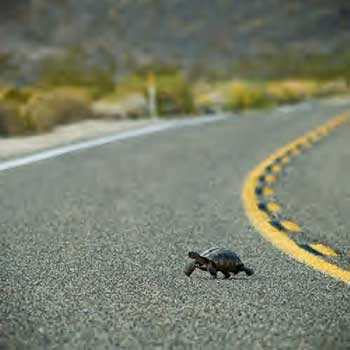
You mostly see turtles crossing roads between April and October. They do this for many reasons. In the spring, male turtles are looking for females and territory to call their own, while females are looking for places to nest. During the spring, late summer and fall, hatchling turtles are digging up from nests, looking for water. Later on, males and females are heading for places to hibernate. Sometimes they are migrating to a more suitable spot to live.
For whatever reasons these turtles are traveling, their destination can take them miles away from the water they came from. With increasing human development, turtles must cross more roads. We can help them immensely by taking only a few minutes out of our day.
Determine if the turtle is injured
When you come across a turtle in the road, there is a strong possibility that it has been injured while trying to cross. An injured turtle released into the wild without medical treatment will struggle to survive, facing risk of infection, dehydration, and predator attacks. It is crucial to identify when a turtle is injured so you can get them help!
Step one happens before you approach the turtle. Try to observe and determine which direction the turtle is or was trying to go before you get too close and change the turtle’s behavior. If the the turtle is not injured, you want to move it to where it was headed, not back to where it came from. Do not assume it was heading to water. You won’t always be able to make this determination, but when you can, you should.
One of the most noticeable signs of injury is a “crack,” or fracture through the shell. You may notice blood on or around the shell, and there may be more than one fracture. When you lift the turtle to bring them to safety, gently look underneath them at their “belly,” or plastron. Sometimes, turtles will have fractures only on their plastron, so it is important to check if you don’t see other signs of injury.
Another common sign of injury is seeing blood around the head, mouth, or arms. When a turtle has an injury to the head, they may pull their head deep into their shell due to fear and pain. Even with their head tucked in, you may be able to see blood, but if you are unsure, gently set them in a box and wait for them to look around. The turtle may take several minutes to be comfortable enough to look around, so be patient!
Turtle injuries can be complex, so be sure to check the surroundings before assuming a turtle is uninjured. Sometimes, there will be blood on the asphalt underneath or nearby the turtle without a clear cause. Blood always indicates an injury, so click the “Help an Injured Turtle” button below!
If you are having trouble determining whether or not a turtle is injured, it is best to ERR ON THE SIDE OF CAUTION and treat them as if they are. Put the turtle in a box and take photos of the top and bottom of the turtle’s shell and a photo of the head, then click the “Help an Injured Turtle” button below. If you leave the site, be sure to take the turtle with you.
Tips For Moving Turtles
- When picking up a small turtle, grasp it on either side of its shell behind the front legs. The turtle will still be able to kick at you, but many will choose to stay safely tucked in, during the short time you are moving them.
- When moving turtles, keep them low to the ground. Even small turtles have surprising strength. Many turtles will release a special reserve of water (not pee!) when picked up. If a turtle pushes free of your grip, or startles you by releasing their water reserves, you do not want it to fall and cause injury.
- If the turtle is large (with a long tail), it may be a snapping turtle. They can be a bit aggressive and you might not want to attempt picking them up, but you can still help it across the road.
- If you are helping a large snapper, you can simply push it from behind with a blunt object. Don’t use anything sharp or pokey, you don’t want to hurt the turtle. Although snappers can seem dangerous, they are just protecting the babies they are carrying. Like with any wild animal, you need to exercise caution.
- Make sure to move the turtle in the direction it was heading, NEVER TURN THEM AROUND! The turtle is on a mission, and if you turn it around, it will simply go back across the road when you drive away.
- Once you have the turtle across the road, you can sit and watch to make sure it is heading off and not turning back around.
- Although you may be tempted to relocate a turtle, don’t. Many turtles have a “home range,” a territory they call home, and when relocated, they will search for ways back. Besides risking many additional road crossings, some turtles, if they cannot find their way back will stop eating and wander aimlessly.
NEVER PICK UP ANY TURTLE BY THE TAIL
This can injure them very badly. If you are not comfortable handling the animal, scoot it into a box or onto a shovel, and move it that way.