
Turtle Hatchlings – Not Always Cute and Probably Not Dying
Turtle Rescue League works hard to ensure every turtle has a chance. In 2021, we incubated many turtle eggs and cared for the hatchlings until release conditions were just right. They came from our patients, were taken from construction sites, and were recovered from females who were killed on the way to their nesting grounds.
Are you ready to learn what to do when you encounter a turtle hatchling? It’s important to know – a wild turtle living out its full natural lifespan, nesting every year, is lucky to have a single hatchling grow to adulthood. Help make it happen!
Read on to become someone who can help hatchlings in need. Use the outline below to jump around if you need specific information fast.
- Why should I contact a licensed wildlife rehabber?
- How to transport or hold onto a hatchling for a rehabber
- What kind of turtles are we talking about?
- Common reasons hatchlings need help
- Hatchling in or near the road
- Where to bring or release a hatchling
- Turtle hatchlings don’t need mom or dad
- Turtle hatchlings don’t need their brothers and sisters
- You can help prevent problems for hatchlings
- A general timeline for hatchlings in Massachusetts
- Help us help hatchlings!
A Common Scenario
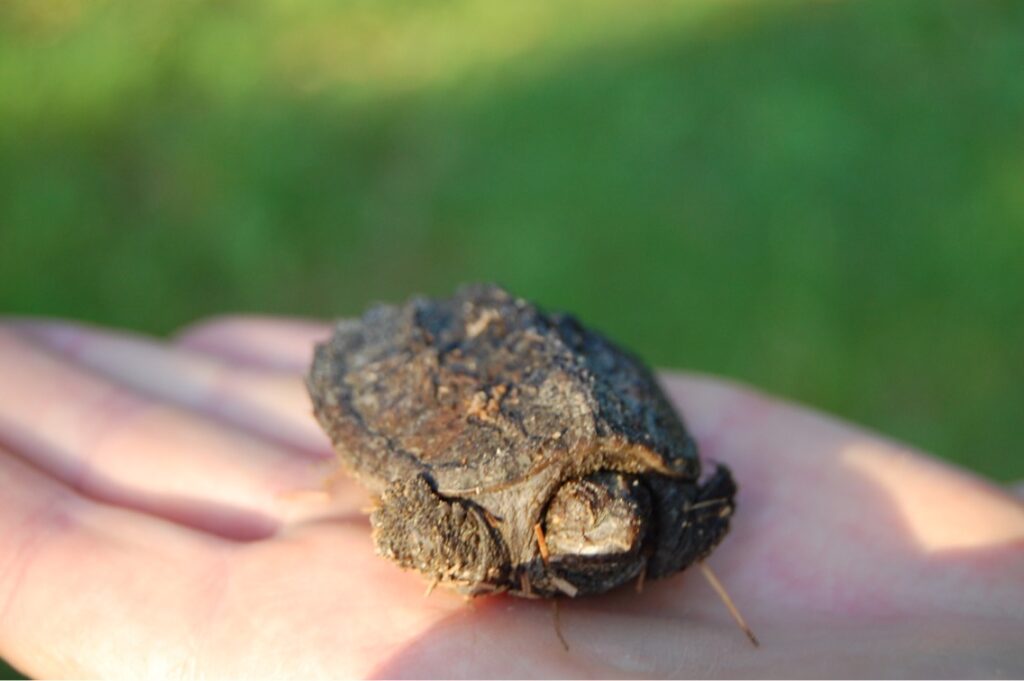
Let’s say you find a turtle hatchling on the ground on a walk around your neighborhood. There’s no pond you can see, and it looks shriveled and has puffy eyes. It’s covered in dirt. It’s moving very slowly and it might be injured – there are guts sticking out from its bottom shell.

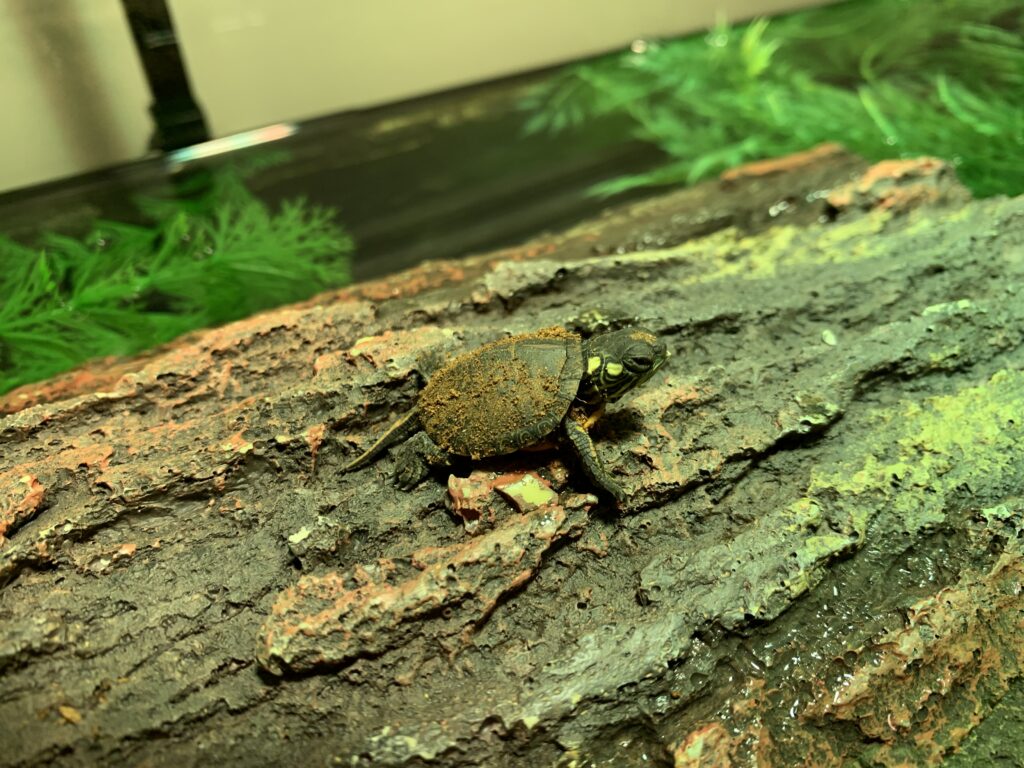
It’s dying and you should take it home… right?
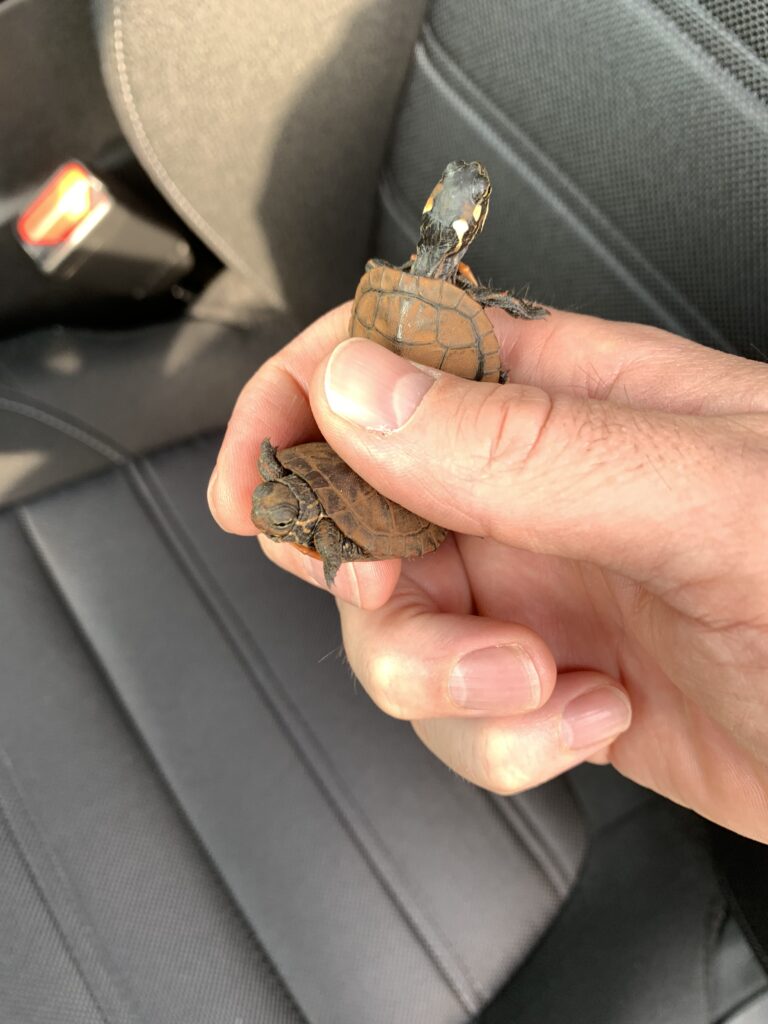
Field guides, cartoons, and documentaries feature adorable turtle hatchlings with bold bright colors and pristine shells. Yes, these are hatchlings, but probably ones that have been out of the nest for a day or two. That’s when they start to look the way we tend to picture them, especially after they’ve been in the water.
In this case, good intentions aside, the answer is probably no, you should not take it home. Turtle hatchlings aren’t always cute and they probably aren’t dying. This is important to understand so when you see one, you’ll know what to do, or not to do. And instead of assuming you did the right thing, you’ll know you did.
If a Hatchling Needs To Go To Your Home, It Needs a Licensed Rehabber
There are plenty of reasons a hatchling may find itself in need of help. There is no case in which you should take a hatchling home for any longer than it takes to connect with a licensed wildlife rehabber. It may also be illegal to do so.
Before we interact with any wildlife, even with good intentions, it is very important to stop for a moment and think. Ask yourself – do I know what this animal needs? Am I making assumptions? Am I hoping it needs help because I want to care for it?
You can always contact a licensed wildlife rehabber, at the least to get a positive species identification on the turtle. While rare, there are hatchlings in Massachusetts where the advice below does not generally apply. This is best done before you take the animal if the circumstances allow. Even if the rehabber’s advice is to walk away, that’s a big help to the hatchling.
Never Transport a Turtle – Especially a Hatchling – in Water!
If a rehabber asks you to hold on to or transport a turtle, put it in a dry box or bin with a dry towel on the bottom, a few air holes and a secure lid. Keep it at room temperature – don’t leave it in direct sun. In your car, a comfortable temperature for you will work for a hatchling, and if you’re not sure, err on the cool side. Use the same setup while you’re waiting to speak to a rehabber, if you can’t reach one immediately.

We’re Talking About Painted Turtles and Snapping Turtles
This post focuses on the two types of hatchlings you’re most likely to find in Massachusetts – painted turtles and snapping turtles. There are other types of turtle hatchlings you might find here, but they are more rare. If you find a box turtle hatchling, for instance, it would not be helpful to bring it to the edge of the nearest swamp. Identification is another important reason to contact a rehabber. Lots of hatchlings look alike.
Common Situations in Which a Hatchling Needs Help
A Nest Was Dug Up

Gardening, yard work, dogs, wild animals and construction projects are common reasons a nest is dug up. Depending on the time of year, the nest contains eggs, hatchlings, or both. We’ll talk about eggs in another post.
The main problem here is that the hatchlings don’t hang around in the nest any longer than they have to. When conditions are right, they leave. If they are dug up, it is probably too early for them to be out. If the wetlands aren’t green and you’re not noticing plenty of insects, the water is probably too cold. The wetland will be lacking sufficient cover and hiding spots, and not providing enough food.
If the hatchling has a large, wet yolk sac on its belly, chances are it was forced out of its nest early.
Your job now is to find a qualified rehabber.

A Hatchling is in or Approaching a Road

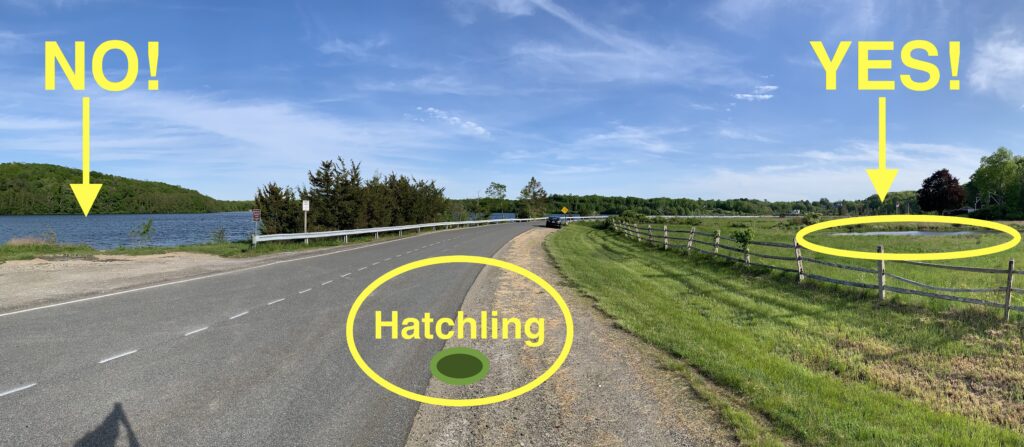
Here is the best and most common chance to help a hatchling! Hatchlings are easier for people to see on or near roads than they are in grass or fallen leaves, so we notice them there. You can greatly improve the odds for a hatchling by gently picking it up (even snapping turtle hatchlings can’t hurt you with a bite or their claws) and SAFELY walking it across the street. You can put the hatchling directly on the other side of the road, or take it all the way to the nearest wetland in that general direction. That can be quite far, but for the most part, not far enough for you to not be able to get a sense of where the wetland/water is. Google Maps can be helpful.
Another reason this is such a common situation is that turtles don’t have many good places left to lay eggs between their wetland home and the nearest road. Due to pavement, patios, fences, etc., suitable nesting sites are harder to come by every year. When you see a hatchling, take a quick look around for more if you can.
Learn more about turtles and roads here!
Where to Release a Turtle Hatchling
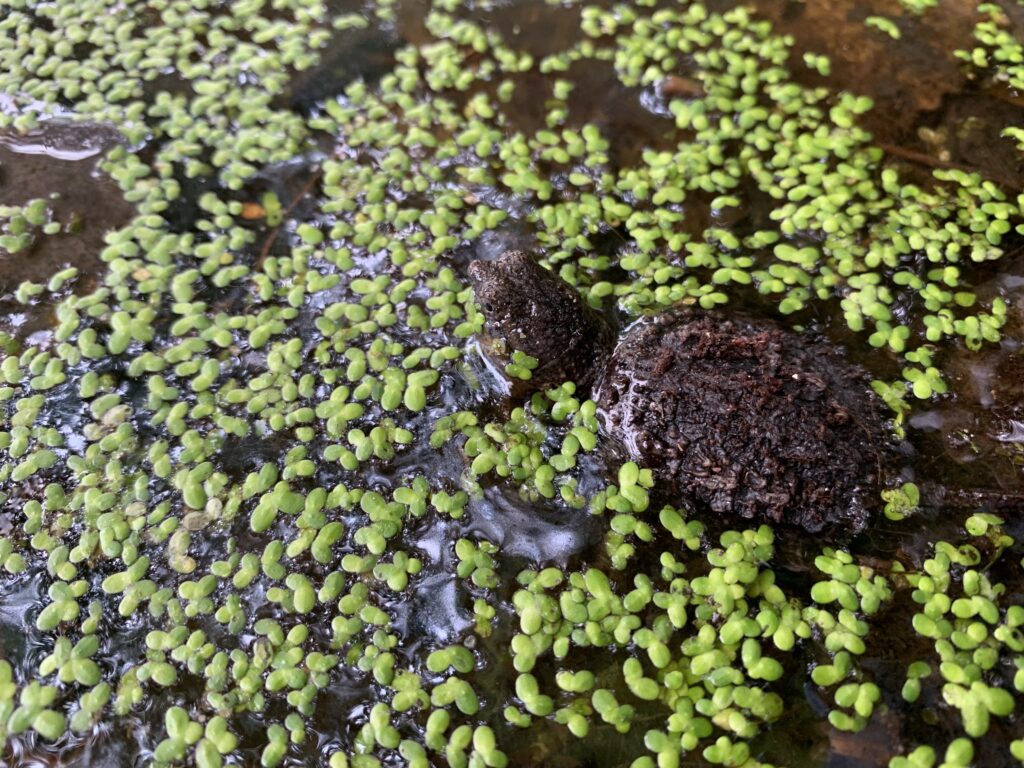
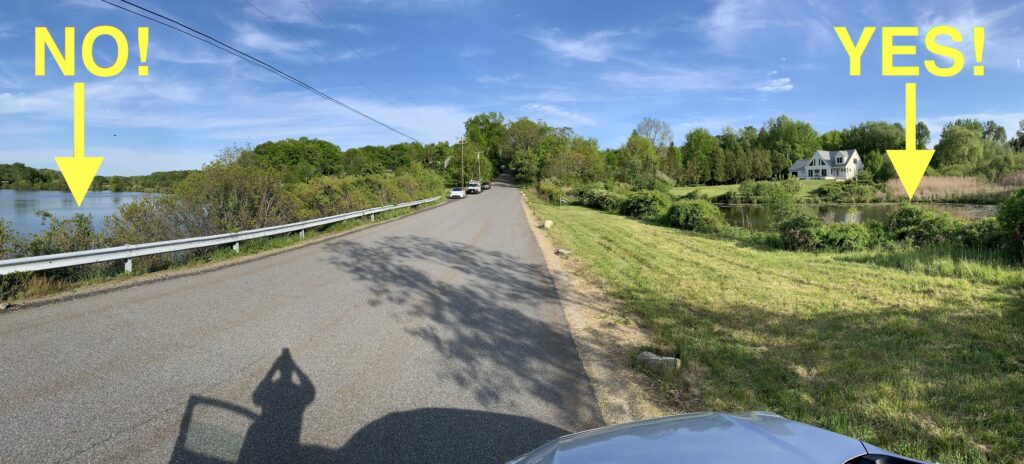
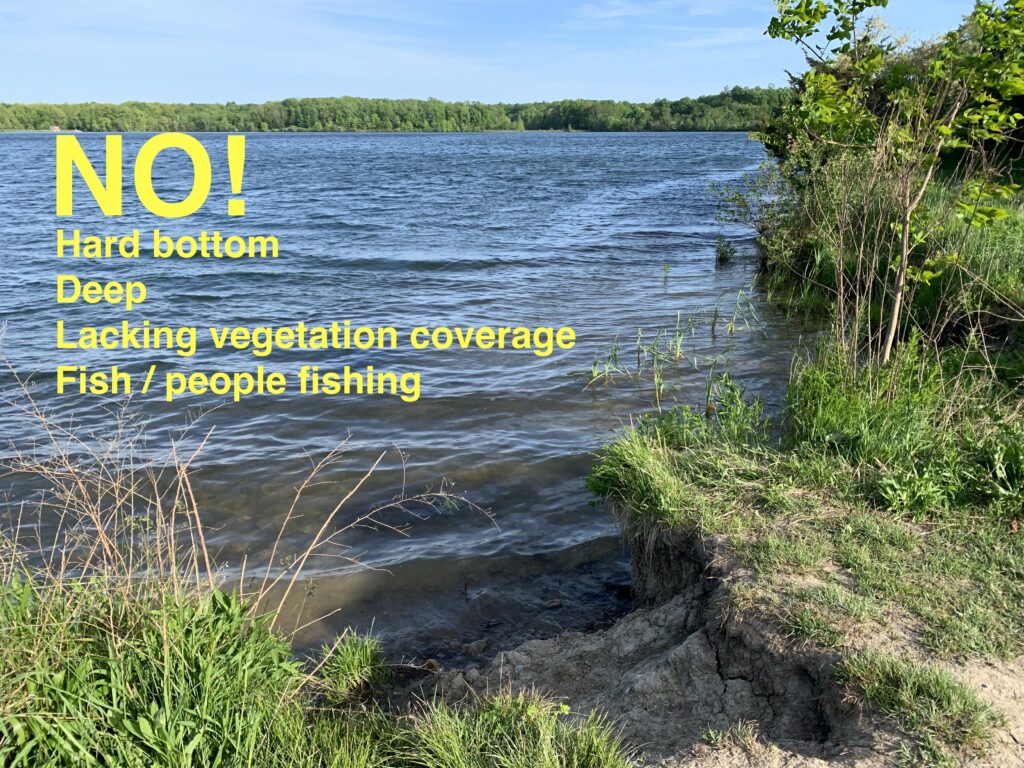
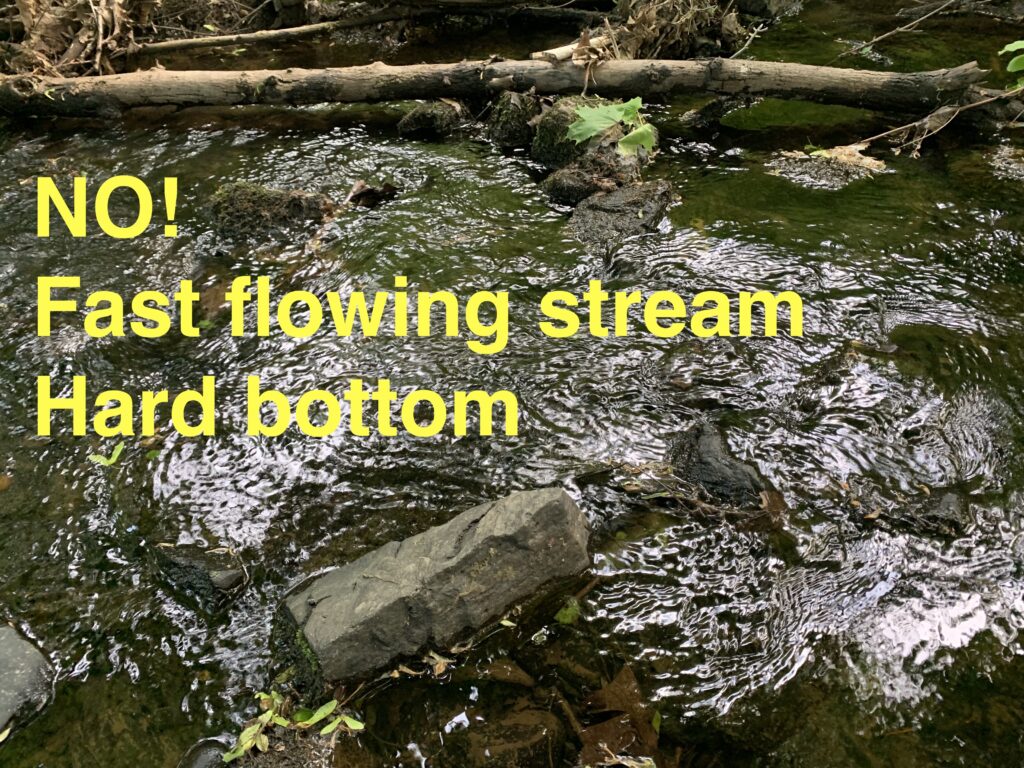
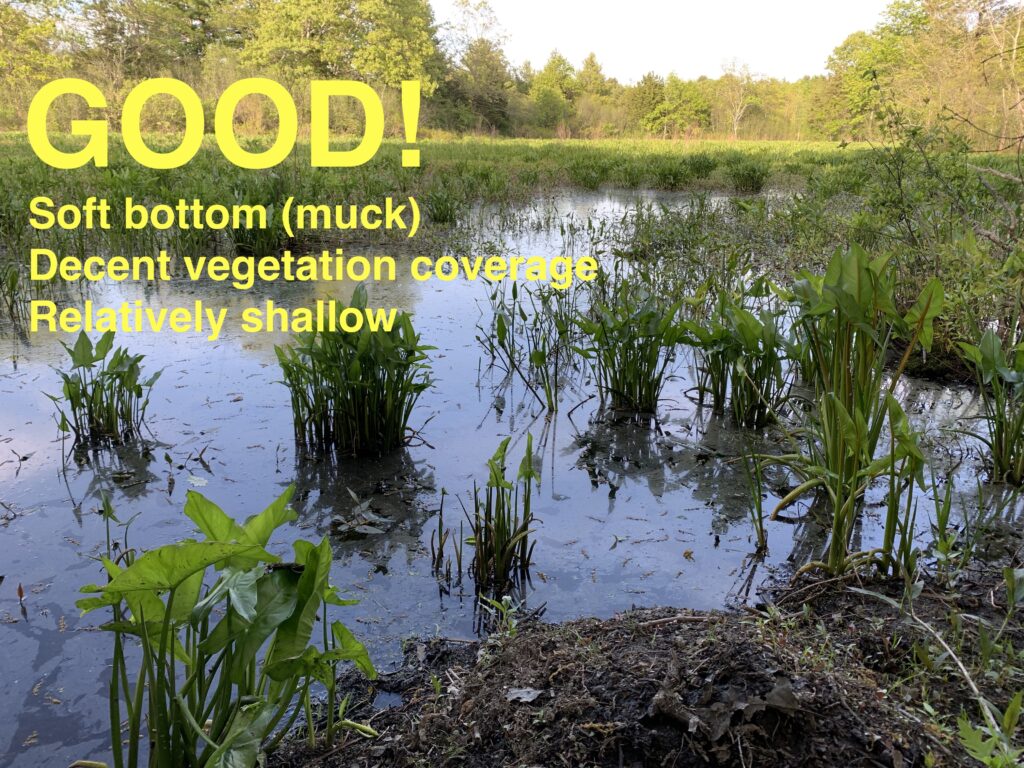
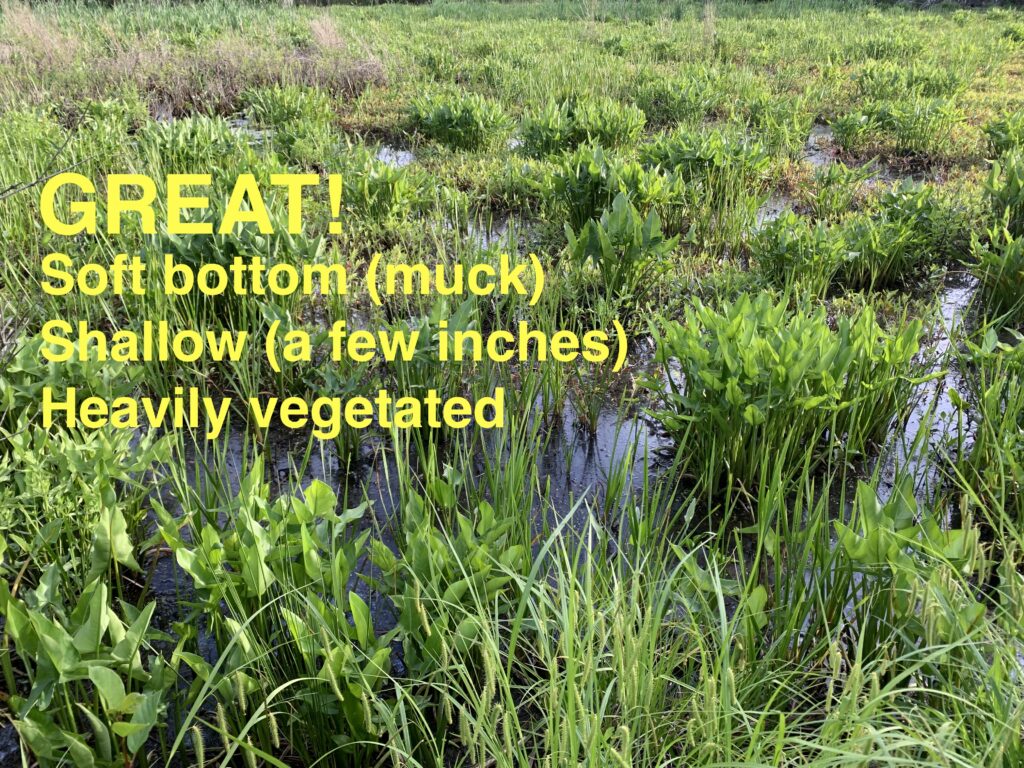
Don’t bring a hatchling to a sandy beach area, a deep, open pond, or a fast flowing stream. Good hatchling release spots are shallow with lots of muck on the bottom and plants in the water. Remember, you don’t need to take it all the way to the water. You can give it an assist for part of the way in the correct direction. Better to take it half way to the water or just across the road than to take it to a poor spot because you don’t have boots with you. Put a fallen leaf on it so it has cover while it regains its composure, and you’ve helped it out quite a bit.
If you do take it all the way to good swampy water, place it on the edge so it can enter the water on its own. If you need to leave before it goes in, cover it with a leaf.
Turtle Hatchlings Don’t Need Mom or Dad
There are no orphaned turtles in Massachusetts (or in most of the world). Turtle hatchlings don’t need mom or dad. From the moment mom lays the eggs and carefully covers her nest, she heads back to the water and they are on their own.
Like many reptiles, they are fully capable of surviving on their own from the moment they hatch. This doesn’t mean they aren’t vulnerable – they are tiny, soft and slow. It does mean that they should not be taken home because they “lost mom.”
Turtle Hatchlings Don’t Need Their Brothers and Sisters
When they leave the nest, which may contain a few or dozens of hatchlings, they are on their own. Sometimes all the hatchlings in a nest leave at the same time. Sometimes it may be days before they all leave.
It is quite common for all of the hatchlings in an area, a neighborhood, a town or region to dig out and head for water on the same day. It is also possible for hatchlings in nests a few feet apart to leave many days apart.
Even these small groups that dig out at the same time usually become separated very quickly after leaving the nest. One hatchling goes left around a fence post or a rock, and the other goes right, and they are off on different trajectories toward the wetland.
This is good – almost everything eats turtle hatchlings. A wandering predator stumbling upon a hatchling is better for turtle populations than if the same predator happens upon all the hatchlings from a nest.
Great Ways to Prevent Problems for Hatchlings
- Cover mulch, sand and loam piles with a tarp. Turtles will find these from great distances and lay eggs in them whether they are small piles or 20 feet tall. Often, especially with mulch, eggs won’t survive even if the pile is undisturbed (which is rarely the case). Over time, they get hotter than they were when the mother turtle comes along.
- Walk your lawn before mowing, and mow on the highest setting. This is safer for hatchlings and adult turtles, and many other animals.
- Don’t attract predators. Take out trash just before pickup, or as close as possible. Keep it covered and secure. Some of the most common predators are raccoons, skunks and crows. Some of the populations of these animals are artificially high due to abundant food (trash) provided by humans.
- Be careful when gardening and landscaping. If you hire landscapers, let them know you expect them to respect wildlife. Use shovels and trowels carefully. If you see a turtle laying eggs, remember where it was. The turtle will disguise the nest well, so take a photo or make a note. You can be careful when you work in that area. Do not try to physically protect the nest unless you are very sure you can do it correctly – it’s a big commitment and can kill the eggs or hatchlings if not done properly. Contact us. You can tell neighbors about a nest if you know of one in their yard.
- Do not try to relocate a nest without contacting a licensed rehabber. It is not simple or easy to do. Even rotating an egg will kill the turtle inside. If you move a nest, you are committing to months of close monitoring.
General Hatchling Timeline (Massachusetts)
The timing will be different every year, as it is largely driven by weather. But in general, this is a hatchling timeline for Massachusetts, starting with April, as this is the month where many people first see turtles for the year.
April
- If it’s a warm April, or if something has disturbed a nest (yard cleanup is common this month) you may see painted turtle hatchlings. Often, they won’t emerge until May.
May
- If you’re looking, you’ll certainly see hatchlings in May. The wetlands should be turning green, there are insects, and days over 70 degrees are starting to become the norm.
June
- The vast majority of the hatchlings that survived the journey have made it to wetlands. You might see them hidden in shallow, still, thickly vegetated water. Their priorities for at least a year or two are to hide (not be eaten), eat, and bask. Basking helps them grow as much as eating does!
- It is not uncommon, especially in early June, for some painted turtles to still be emerging from nests.
July
- Painted turtle hatchlings are in the water, much like June.
- Toward the end of July, weather depending and certainly if a nest is disturbed, it is possible for snapping turtle hatchlings to leave their nests. Treat just the same as painted turtle hatchlings, and remember, they can not hurt you as hatchlings.
August
- In August, snapping turtles will be emerging from their nests.
- Painted turtle eggs are hatching – but the hatchlings plan on staying in the nest over the winter. However, if a nest is disturbed for any of the reasons you’ve read about here, you may see painted turtle hatchlings. Call a licensed rehabber if you find a painted turtle hatchling on land in August or later.
September
- The later snapping turtle hatchlings may still be emerging from nests, especially if it has been an unusual summer in terms of weather.
- Like August, you may find painted turtle hatchlings from nests that have been disturbed. Call a licensed rehabber.
October
- Like April, it’s unusual but not uncommon to find hatchlings. For this month, contact a rehabber for advice on any hatchling you find on land.
November – March
- Best to contact a rehabber for any species of turtle hatchling, or really any turtle regardless of age you find this time of year.
Help Us Help Turtles!
Whether you’re on the lookout for hatchlings or not, you can support the Turtle Rescue League and our patients by making a single or a recurring donation of any amount. We rely completely on your support. Thank you!