
Does A Three-Legged Turtle Need Help?
Does a three-legged turtle need help? Picture this. You’re being a hero, helping a turtle across a street in the direction it was heading (thank you!). As you gently lift it up to carry it across, it begins to wave its legs, like it’s swimming in the air.
Nothing unusual here! You’ve seen this behavior before.
As you bend to place it gently in the tall grass on the other side, you notice that only three legs are waving. Upon closer inspection you find the leg that isn’t waving wildly is just a stump. The stump is actually waving, too, but it is so short it’s hidden under the shell.

Now, that is unusual! But not as unusual as you might think.
Turtles are extremely adaptable creatures. You don’t get to stay on Earth for hundreds of millions of years without being tough. So, does a three-legged turtle need help? Usually, no. It’s going to be just fine.
Let’s talk through some questions many people have when they encounter a three-legged turtle for the first time.
But first, since our goal is always to help any turtle that needs it as quickly as possible, we’ll take a look at when a three-legged turtle does need help.
When Does a Three-Legged Turtle Need Help?
If the loss of a leg is recent, you’ve found an injured turtle and the right thing to do is to contact a licensed rehabber like Turtle Rescue League.
You’ll know the loss is recent if any of the below are true.
- The stump or hole is bleeding.
- The area is covered in coagulated blood (clots).
- You can see white (newly exposed) bone.
- Part of the leg is still hanging on but obviously disconnected or “cut off.”
- The area where the leg was is thick with flies or maggots.
- The turtle has a very foul smell that is hard to miss (snapping and musk turtles can release a stink, but this will be obvious even if you’ve never smelled a snapping or musk turtle).
Turtles that lose a leg to a predator or an environmental accident are absolutely at risk of death. Some who lose a leg do die in the following days or weeks. A licensed rehabber will protect against infection and provide any other necessary treatment, while giving the turtle time to adjust before returning to the wild.
If the turtle is missing more than one leg, contact us. It might be fine, but tell us about it and we’ll figure it out together.

Whether it received help from a rehabber or survived the injury on its own, below you’ll be learning about turtles who have survived losing a limb, healed, put it in their past, and are simply going about the business of being a wild turtle.
Can a Three-Legged Turtle Swim?
Yes! A turtle with three legs will very quickly adapt its technique and swim just fine. It will also be able to climb up and out of the water to bask or get on land when it needs to.
If it is young, as many are when they lose a leg, it will adapt even faster. It won’t need to “relearn” much.

Can a Three-Legged Turtle Walk or Climb?
Turtles are determined and capable. You might see a three-legged turtle climbing stone walls, logs, or steep slopes. They do it all. It might not be pretty, and can be slow, even for a turtle, but they can do it.
They can climb out of the water onto a log or rock to bask just fine, too.

Since some terrain or obstacles can slow things down for a three-legged turtle, they tend to be out of the water longer than other turtles. More time means more exposure to people, dogs, hawks, raccoons and other predators. You don’t want to intervene if it’s not necessary, but when helping is the right thing to do, it can really save them some time and reduce risk.
If in doubt, contact us!
What About a Three-Legged Turtle That Gets Turned Upside Down? Can it Flip Back Over?
Almost always the answer is “yes.” To survive in the wild, a turtle absolutely needs the ability to right itself when it flips over. For turtles in our area, the hardest work in the righting motion is performed by the head, neck and tail. If it does need an assist from the legs, it will use the side with both of them.

Can a Three-Legged Turtle Dig a Nest?
It might take a little longer, but three-legged turtles can and do dig nests and lay eggs. It’s a lot of work for that one hind leg, if the missing leg is also a hind leg. But they get it done. Turtles don’t give up.
As with all nesting turtles, but especially with a three-legged turtle, give it plenty of space while it is nesting. If you scare it while it’s digging the nest, it needs to go find somewhere else. Plenty of space means at least 20 feet, and it should be more.
The best thing to do with any nesting turtle is to take a good quick look from a distance, and then leave. Don’t be a source of stress or make her take longer than she needs to. Feel good about doing the right thing.
The process often takes more than 2 hours, and you can’t really see much. The view from 50 feet is just as good as it is at 10 feet.
You may have heard of a “nesting trance.” This can happen with some turtles while the eggs are actually being laid. It does not happen while the mother turtle is searching for a good spot, digging the nest or filling in the nest. In the “trance,” mom might seem to not notice you if you stand right next to her. Please be aware that she knows you are there, and you’re causing her a lot of stress. She just can’t physically stop what she’s doing at this point. As above, take a good look at the amazing event you happened upon, and move along.
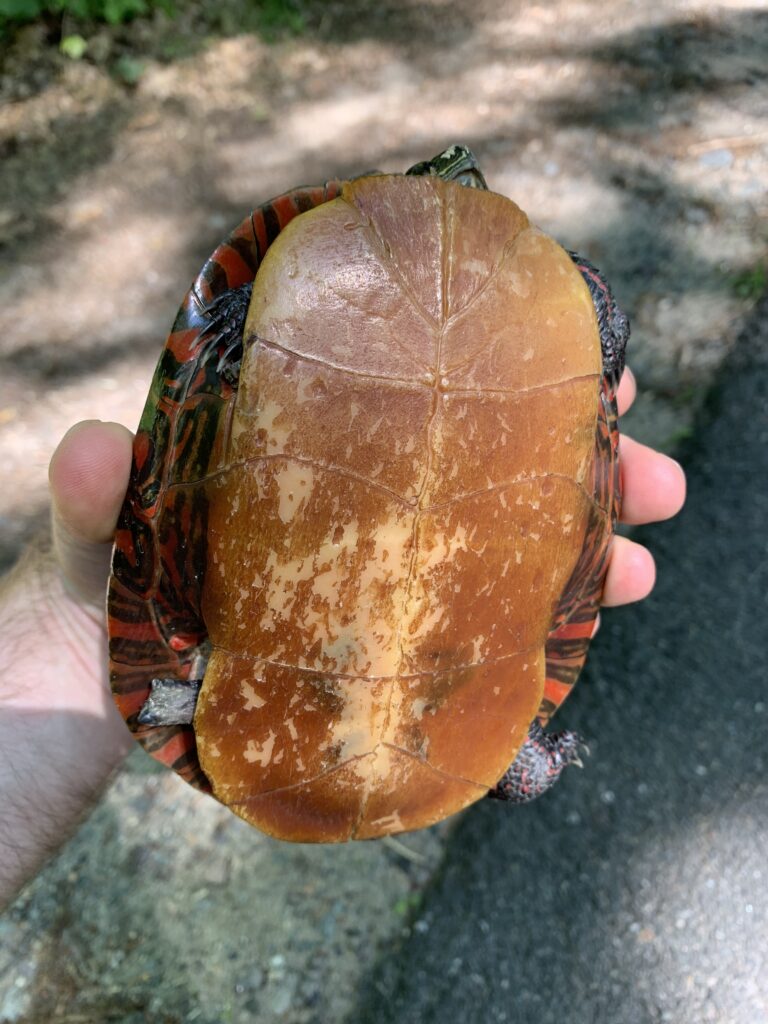
Can a Three-Legged Turtle Catch Food? Can it Eat?
Yes, a three-legged turtle can catch food and eat.
Most turtles in our area eat mainly plants and dead animals they find. Neither of those is going to put up much of a fight or a chase. And lots of the live animal prey they eat isn’t moving too fast, either. We’re talking about you, snails.
We see plenty of well fed three-legged turtles in the wild every year.
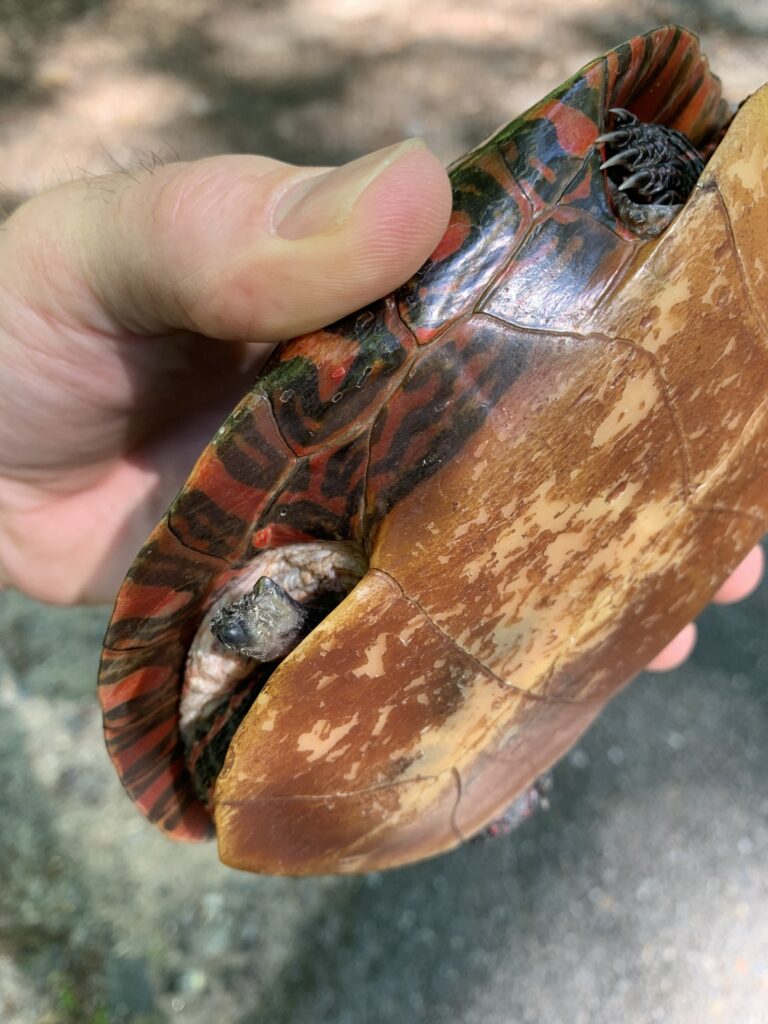
Can a Three-Legged Turtle Hibernate and Survive the Winter?
Instead of hibernation, turtles enter brumation. For now, think of brumation as a reptile’s version of hibernation.
But yes, three-legged turtles do make it through the winter. The turtles in our area will bury themselves in the muck on the bottom of their wetlands, jam themselves under a fallen log or into a beaver lodge, or even just sit largely motionless on the bottom until things warm up in March, April or May.
Burying itself down in the muck is a piece of cake compared to digging and filling in a nest!
How Does a Turtle Lose a Leg?
Turtles, even adults, have many predators. Some of these predators have unnaturally large populations because they receive so many favors from humans – think food waste and shelter. Learn how to prevent that here.
Let’s look at how hatchlings and adults might lose a leg.
Hatchlings
After hatching from eggs but before leaving the nest, turtles are vulnerable. Here are some ways a hatchling may lose a leg, or its life, while in the nest or on its journey to find a wetland.
- Dogs, raccoons, skunks, chipmunks, foxes, crows and plenty of other animals will dig up a nest if they smell or otherwise detect it. This usually results in the death of all the eggs or hatchlings in the nest, but sometimes, one or more will escape. Usually an escape with a leg injury implies the predator hit the turtle with its claws while it was digging up the nest but the turtle remained hidden in the soil (otherwise it surely would have been eaten).
- Trowels, shovels and other gardening equipment are unknowingly thrust into many a nest. The gardener may not ever realize it happened. A hit from a digging tool can easily kill a hatchling or take off a leg.
- When humans kidnap hatchlings from the wild, we expose them to new risks. There are lots of human hairs in your home. There are also loose fibers on towels or washcloths someone might use to transport the hatchling. It is amazing how easily hairs and fibers can tangle around a hatchling’s limbs (including it’s neck!). They are very hard to notice. These cut off circulation and unfortunately, it doesn’t take long for the limb to die. Whether it falls off, is found hanging off the hatchling or stays on and causes infection, it’s another common scenario that befalls turtles stolen from the wild. This happens to adult turtles as well, but we don’t see it as often.
- River otters may also chew the legs off hatchlings, especially in drought conditions when other food sources are scarce. Usually, if a river otter catches a hatchling, it will eat the entire turtle.
Juveniles and Adults
Older, larger, more experienced turtles don’t have as many predators to deal with as hatchlings do, but they still have some. Adults usually lose legs to these predators or to humans with machines.
- River otters may eat some or all of the legs off larger turtles, especially in times of drought. Juveniles and adults have a better chance of surviving these encounters than hatchlings do.
- Some predators won’t bother with full grown turtles. Raccoons, foxes, hawks and some others certainly will. The turtle may lose a limb before it fights off or escapes from the predator.
- Dogs kill and injure turtles every year. We think we “know” our dogs, but dogs are predators. It’s not a bad thing, that’s just the way it is. Understand that if your dog is off leash and out of sight in a wild space it could be disturbing or injuring wildlife. You might not see it, but it happens.
- Lawn mowers, weed whackers and other gardening equipment take turtle limbs and lives. Walk your lawn before you mow and set your mower to a high setting. Pay attention as you mow or work. Tell landscapers you expect them to respect wildlife.

However a turtle happens to lose a leg, if it survives the injury it can go on to live a long, happy turtle life. If you see a three-legged turtle that seems happy and healthy, it probably is.
If it’s upside down, turn it back over like you might help any other turtle. Help it across the street in the direction it was headed.
Unless you get the sense the injury was recent, it’s best to move on. Don’t add extra time or distance to the journeys of these capable but just a little bit more vulnerable turtles.
HELP US HELP TURTLES!
You can support the two-legged, three-legged and four-legged patients at Turtle Rescue League with a single or recurring donation of any amount. We rely completely on the support of turtle lovers like you. Thank you!